


Comprehensive Environmental Analysis: Advanced Workflows For Water Quality And Microplastics

Shimadzu’s Total Solutions For Environmental Analysis

For decades, Shimadzu has led the field of environmental analysis, providing scientists with innovative instruments to detect, identify, and measure trace-level pollutants. These total solutions cover environmental monitoring across air, soil, and water (including drinking, wastewater, and surface water). Shimadzu addresses current global needs—ranging from regulated contaminants like pesticides, anions, and dioxins to emerging threats such as microplastics, PFAS, and greenhouse gases (CO2, CH4, N2O). Advanced technology portfolios include:
-
Chromatography
GC, LC, SFC
-
Mass Spectrometry
GC-MS, LC-MS, MALDI
-
Sum Parameter Instruments
Total Organic Carbon (TOC)
-
Spectroscopy
UV-Vis, FTIR, AAS, ICP-OES
Water Quality Monitoring: Latest Solutions And Insights
Water quality directly influences public health, environmental balance, and regulatory compliance. Accurate and reliable monitoring is essential for treating wastewater responsibly, maintaining surface water ecosystems, and safeguarding drinking water. Shimadzu’s leading-edge solutions offer end-to-end workflows that deliver the precision and reliability required to navigate diverse aqueous matrices and complex chemical profiles.
Critical Contaminants Monitored Include:
Existing Contaminants: Heavy Metals, Anions, Volatile Organic Compounds (VOCs), Total Organic Carbon (TOC), Pesticides, Marine Biotoxins Emerging Concerns: PFAS, Microplastics, Pharmaceuticals and Personal Care Products (PPCP), and Off-flavour compounds.
Actionable Insights For Water Safety

Simplify the complexities of water testing with Shimadzu’s workflows. Explore end-to-end analytical methods for industrial effluents, surface water, and drinking water by downloading the full guide here.
Advanced Microplastics Analysis:
Characterizing Risks In The Aquatic Ecosystem

Tiny plastic fragments ranging from several micrometers µm up to 5 mm are classified as microplastics, presenting one of the most pervasive ecological threats of our time. These ultra-fine pollutants pose an escalating threat to marine environments and ecosystems, accumulating rapidly in waterways, soil, and even remote atmospheric zones. Because of their microscopic size and complex chemical variations, identifying, quantifying, and mapping microplastic pollution demands highly specialized analytical instrumentation.
Laboratories worldwide are increasingly tasked with establishing reliable, standardized testing protocols to determine not only the polymer type but also the chemical additives carrying latent environmental risks. Shimadzu addresses these testing challenges by providing diverse analytical and measuring instruments specifically optimized for advanced microplastics research—from material characterization and quality control to long-term degradation analysis.
Microplastics enter ecosystems through two main classifications:
-
Primary Microplastics
Manufactured plastic beads utilized in industrial polishing powders, scrubbing agents, and cosmetic cosmetics
-
Secondary Microplastics
Small fragments generated through the physical wear and ultraviolet (UV) degradation of larger plastic debris released into the environment
When swept into marine environments, these pieces are inadvertently consumed by marine life. This presents severe physical risks, such as blockages or lacerations in digestive organs.
Chemical Risks And Biomagnification
Beyond physical damage, microplastics act as chemical vectors:
- Inherent Additives: They leach toxic compounding ingredients such as plasticizers, flame retardants, and antioxidants directly into host organ`sms.
- Adsorbed Pollutants: Their surfaces absorb hazardous hydrophobic environmental toxins, including PCBs and DDT. As these contaminated organisms are consumed, these toxic compounds accumulate up the food chain, triggering biomagnification that potentially threatens human health through food and atmospheric consumption.
Workflow For Selecting An Analysis And Measurement Method
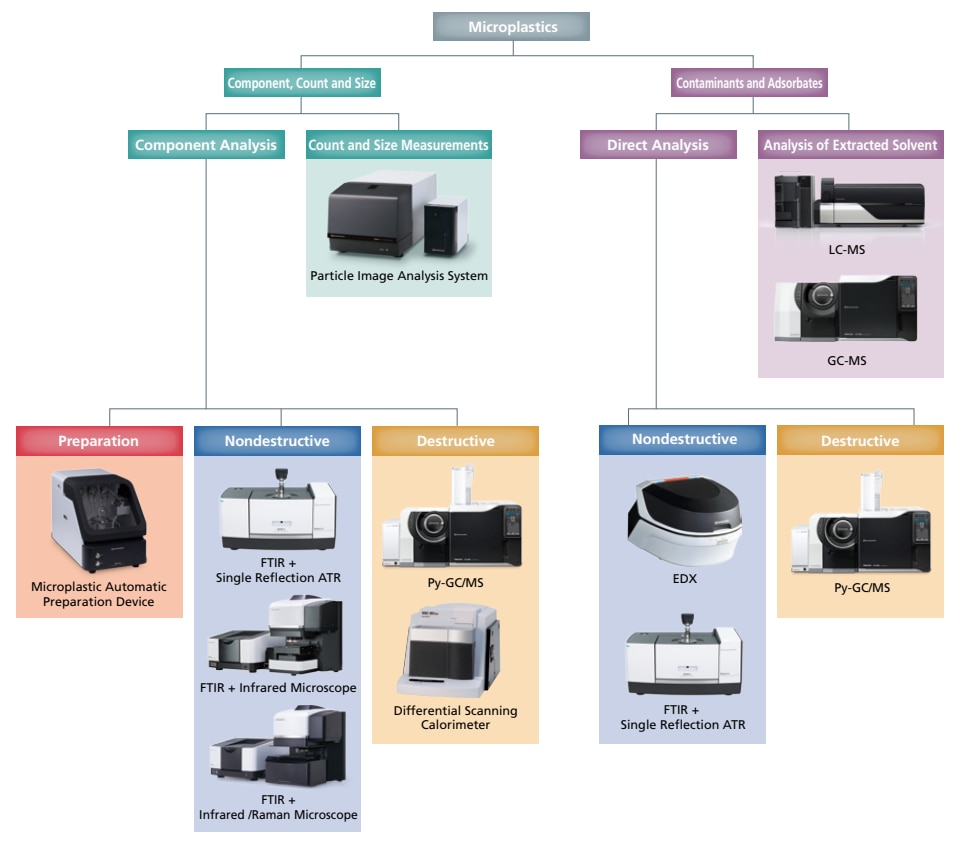
Because microplastic samples vary drastically in size, polymer type, and environmental degradation, choosing the correct analytical method depends entirely on your specific measurement objectives. To streamline your laboratory operations, Shimadzu offers an optimized selection flowchart detailing both non-destructive surface screening and destructive chemical characterization.
Non-Destructive Component Analysis
For rapid, surface-level polymer identification, techniques like Fourier Transform Infrared Spectroscopy (FTIR), Infrared Microscopy, and X-ray Fluorescence (XRF) Spectrometry allow for easy component analysis without altering the physical structure of the sample.
Destructive Sample Analysis
When your research requires deep material profiling, Pyrolysis Gas Chromatography-Mass Spectrometry (Py-GC-MS) is the ideal choice. Although the sample is destroyed via thermal pyrolysis, this advanced method reveals the internal composition of materials and enables the simultaneous analysis of complex, mixed samples containing multiple distinct plastic components.
Optimize Your Microplastics Lab Workflow
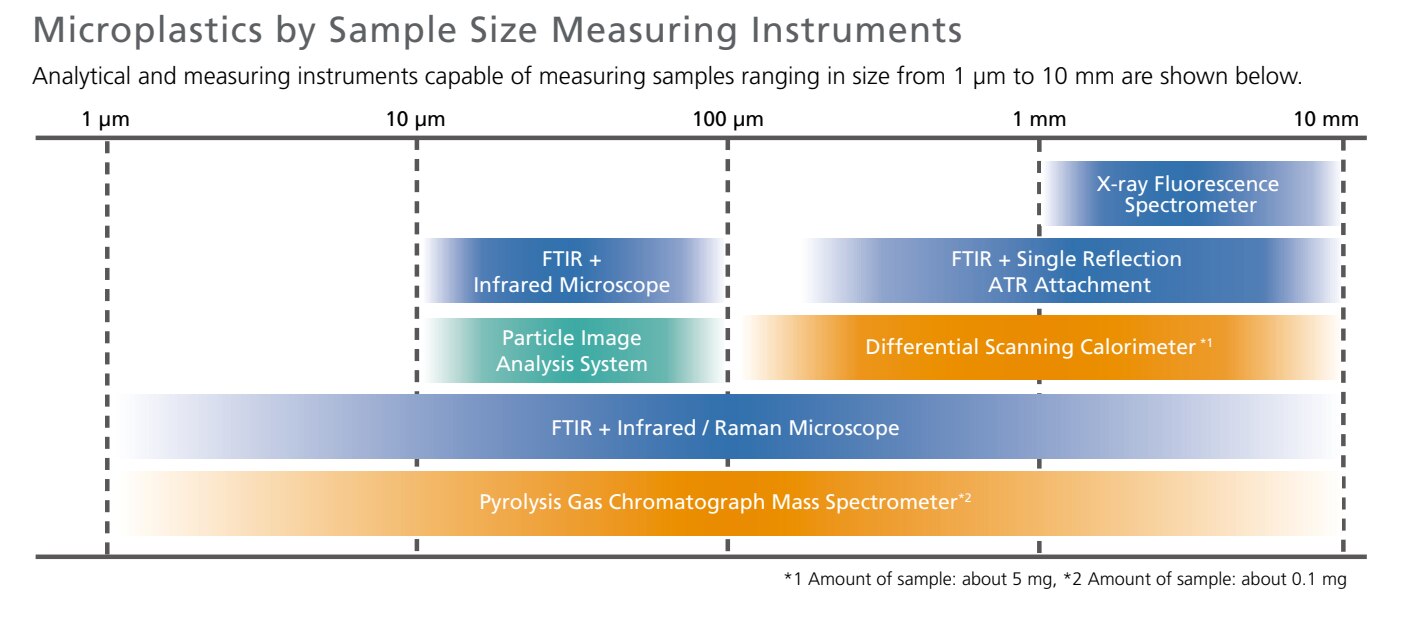
Streamline your research from characteristic evaluation to degradation analysis. Access the complete selection flowcharts, instrumentation specs, and application notes by downloading the guide here.